Example 2: XOR Binary Classification
The next code creates a PyTorch model to build the XOR binary classification problem. Let’s highlight the changes compared to the previous example.
import torch
import torchga
import pygad

def fitness_func(ga_instance, solution, sol_idx):
    global data_inputs, data_outputs, torch_ga, model, loss_function

    predictions = pygad.torchga.predict(model=model,
                                        solution=solution,
                                        data=data_inputs)

    solution_fitness = 1.0 / (loss_function(predictions, data_outputs).detach().numpy() + 0.00000001)

    return solution_fitness

def on_generation(ga_instance):
    print(f"Generation = {ga_instance.generations_completed}")
    print(f"Fitness    = {ga_instance.best_solution()[1]}")

# Create the PyTorch model.
input_layer  = torch.nn.Linear(2, 4)
relu_layer = torch.nn.ReLU()
dense_layer = torch.nn.Linear(4, 2)
output_layer = torch.nn.Softmax(1)

model = torch.nn.Sequential(input_layer,
                            relu_layer,
                            dense_layer,
                            output_layer)
# print(model)

# Create an instance of the pygad.torchga.TorchGA class to build the initial population.
torch_ga = torchga.TorchGA(model=model,
                           num_solutions=10)

loss_function = torch.nn.BCELoss()

# XOR problem inputs
data_inputs = torch.tensor([[0.0, 0.0],
                            [0.0, 1.0],
                            [1.0, 0.0],
                            [1.0, 1.0]])

# XOR problem outputs
data_outputs = torch.tensor([[1.0, 0.0],
                             [0.0, 1.0],
                             [0.0, 1.0],
                             [1.0, 0.0]])

# Prepare the PyGAD parameters. Check the documentation for more information: https://pygad.readthedocs.io/en/latest/pygad.html#pygad-ga-class
num_generations = 250 # Number of generations.
num_parents_mating = 5 # Number of solutions to be selected as parents in the mating pool.
initial_population = torch_ga.population_weights # Initial population of network weights.

# Create an instance of the pygad.GA class
ga_instance = pygad.GA(num_generations=num_generations,
                       num_parents_mating=num_parents_mating,
                       initial_population=initial_population,
                       fitness_func=fitness_func,
                       on_generation=on_generation)

# Start the genetic algorithm evolution.
ga_instance.run()

# After the generations complete, a plot is shown that summarizes how the fitness values evolve over the generations.
ga_instance.plot_fitness(title="PyGAD & PyTorch - Iteration vs. Fitness", linewidth=4)

# Returning the details of the best solution.
solution, solution_fitness, solution_idx = ga_instance.best_solution()
print(f"Fitness value of the best solution = {solution_fitness}")
print(f"Index of the best solution : {solution_idx}")

# Make predictions based on the best solution.
predictions = pygad.torchga.predict(model=model,
                                    solution=solution,
                                    data=data_inputs)
print("Predictions : \n", predictions.detach().numpy())

# Calculate the binary crossentropy for the trained model.
print("Binary Crossentropy : ", loss_function(predictions, data_outputs).detach().numpy())

# Calculate the classification accuracy of the trained model.
a = torch.max(predictions, axis=1)
b = torch.max(data_outputs, axis=1)
accuracy = torch.sum(a.indices == b.indices) / len(data_outputs)
print("Accuracy : ", accuracy.detach().numpy())
Compared to the previous regression example, here are the changes:
The PyTorch model is changed according to the nature of the problem. Now, it has 2 inputs and 2 outputs with an in-between hidden layer of 4 neurons.
input_layer  = torch.nn.Linear(2, 4)
relu_layer = torch.nn.ReLU()
dense_layer = torch.nn.Linear(4, 2)
output_layer = torch.nn.Softmax(1)

model = torch.nn.Sequential(input_layer,
                            relu_layer,
                            dense_layer,
                            output_layer)
The train data is changed. Note that the output of each sample is a 1D vector of 2 values, 1 for each class.
# XOR problem inputs
data_inputs = torch.tensor([[0.0, 0.0],
                            [0.0, 1.0],
                            [1.0, 0.0],
                            [1.0, 1.0]])

# XOR problem outputs
data_outputs = torch.tensor([[1.0, 0.0],
                             [0.0, 1.0],
                             [0.0, 1.0],
                             [1.0, 0.0]])
The fitness value is calculated based on the binary cross entropy.
loss_function = torch.nn.BCELoss()
After the previous code completes, the next figure shows how the fitness value change by generation.
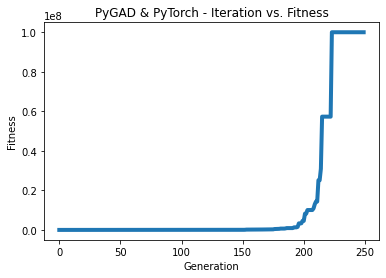
Here is some information about the trained model. Its fitness value is 100000000.0, loss is 0.0 and accuracy is 100%.
Fitness value of the best solution = 100000000.0

Index of the best solution : 0

Predictions :
[[1.0000000e+00 1.3627675e-10]
 [3.8521746e-09 1.0000000e+00]
 [4.2789325e-10 1.0000000e+00]
 [1.0000000e+00 3.3668417e-09]]

Binary Crossentropy :  0.0

Accuracy :  1.0