Regression Example 1
To train a neural network for regression, follow these instructions:
Set the
output_activationparameter in the constructor of thepygad.gann.GANNclass to"None". It is possible to use the ReLU function if all outputs are nonnegative.
GANN_instance = pygad.gann.GANN(...
                                output_activation="None")
Wherever the
pygad.nn.predict()function is used, set theproblem_typeparameter to"regression".
predictions = pygad.nn.predict(...,
                               problem_type="regression")
Design the fitness function to calculate the error (e.g. mean absolute error).
def fitness_func(ga_instance, solution, sol_idx):
    ...

    predictions = pygad.nn.predict(...,
                                   problem_type="regression")

    solution_fitness = 1.0/numpy.mean(numpy.abs(predictions - data_outputs))

    return solution_fitness
The next code builds a complete example for building a neural network for regression.
import numpy
import pygad
import pygad.nn
import pygad.gann

def fitness_func(ga_instance, solution, sol_idx):
    global GANN_instance, data_inputs, data_outputs

    predictions = pygad.nn.predict(last_layer=GANN_instance.population_networks[sol_idx],
                                   data_inputs=data_inputs, problem_type="regression")
    solution_fitness = 1.0/numpy.mean(numpy.abs(predictions - data_outputs))

    return solution_fitness

def callback_generation(ga_instance):
    global GANN_instance, last_fitness

    population_matrices = pygad.gann.population_as_matrices(population_networks=GANN_instance.population_networks,
                                                            population_vectors=ga_instance.population)

    GANN_instance.update_population_trained_weights(population_trained_weights=population_matrices)

    print(f"Generation = {ga_instance.generations_completed}")
    print(f"Fitness    = {ga_instance.best_solution(pop_fitness=ga_instance.last_generation_fitness)[1]}")
    print(f"Change     = {ga_instance.best_solution(pop_fitness=ga_instance.last_generation_fitness)[1] - last_fitness}")

    last_fitness = ga_instance.best_solution(pop_fitness=ga_instance.last_generation_fitness)[1].copy()

# Holds the fitness value of the previous generation.
last_fitness = 0

# Preparing the NumPy array of the inputs.
data_inputs = numpy.array([[2, 5, -3, 0.1],
                           [8, 15, 20, 13]])

# Preparing the NumPy array of the outputs.
data_outputs = numpy.array([[0.1, 0.2],
                            [1.8, 1.5]])

# The length of the input vector for each sample (i.e. number of neurons in the input layer).
num_inputs = data_inputs.shape[1]

# Creating an initial population of neural networks. The return of the initial_population() function holds references to the networks, not their weights. Using such references, the weights of all networks can be fetched.
num_solutions = 6 # A solution or a network can be used interchangeably.
GANN_instance = pygad.gann.GANN(num_solutions=num_solutions,
                                num_neurons_input=num_inputs,
                                num_neurons_hidden_layers=[2],
                                num_neurons_output=2,
                                hidden_activations=["relu"],
                                output_activation="None")

# population does not hold the numerical weights of the network instead it holds a list of references to each last layer of each network (i.e. solution) in the population. A solution or a network can be used interchangeably.
# If there is a population with 3 solutions (i.e. networks), then the population is a list with 3 elements. Each element is a reference to the last layer of each network. Using such a reference, all details of the network can be accessed.
population_vectors = pygad.gann.population_as_vectors(population_networks=GANN_instance.population_networks)

# To prepare the initial population, there are 2 ways:
# 1) Prepare it yourself and pass it to the initial_population parameter. This way is useful when the user wants to start the genetic algorithm with a custom initial population.
# 2) Assign valid integer values to the sol_per_pop and num_genes parameters. If the initial_population parameter exists, then the sol_per_pop and num_genes parameters are useless.
initial_population = population_vectors.copy()

num_parents_mating = 4 # Number of solutions to be selected as parents in the mating pool.

num_generations = 500 # Number of generations.

mutation_percent_genes = 5 # Percentage of genes to mutate. This parameter has no action if the parameter mutation_num_genes exists.

parent_selection_type = "sss" # Type of parent selection.

crossover_type = "single_point" # Type of the crossover operator.

mutation_type = "random" # Type of the mutation operator.

keep_parents = 1 # Number of parents to keep in the next population. -1 means keep all parents and 0 means keep nothing.

init_range_low = -1
init_range_high = 1

ga_instance = pygad.GA(num_generations=num_generations,
                       num_parents_mating=num_parents_mating,
                       initial_population=initial_population,
                       fitness_func=fitness_func,
                       mutation_percent_genes=mutation_percent_genes,
                       init_range_low=init_range_low,
                       init_range_high=init_range_high,
                       parent_selection_type=parent_selection_type,
                       crossover_type=crossover_type,
                       mutation_type=mutation_type,
                       keep_parents=keep_parents,
                       on_generation=callback_generation)

ga_instance.run()

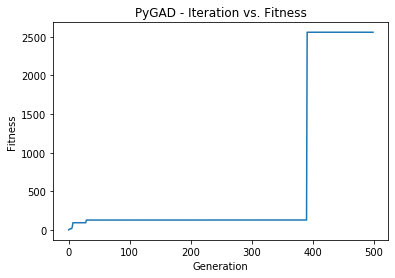
# After the generations complete, a plot is shown that summarizes how the fitness values evolve over the generations.
ga_instance.plot_fitness()

# Returning the details of the best solution.
solution, solution_fitness, solution_idx = ga_instance.best_solution(pop_fitness=ga_instance.last_generation_fitness)
print(f"Parameters of the best solution : {solution}")
print(f"Fitness value of the best solution = {solution_fitness}")
print(f"Index of the best solution : {solution_idx}")

if ga_instance.best_solution_generation != -1:
    print(f"Best fitness value reached after {ga_instance.best_solution_generation} generations.")

# Predicting the outputs of the data using the best solution.
predictions = pygad.nn.predict(last_layer=GANN_instance.population_networks[solution_idx],
                               data_inputs=data_inputs,
                               problem_type="regression")
print(f"Predictions of the trained network : {predictions}")

# Calculating some statistics
abs_error = numpy.mean(numpy.abs(predictions - data_outputs))
print(f"Absolute error : {abs_error}.")
The next figure shows how the fitness value changes for the generations used.