Regression Example 2 - Fish Weight Prediction
This example uses the Fish Market Dataset available at Kaggle (https://www.kaggle.com/aungpyaeap/fish-market). Simply download the CSV dataset from this link (https://www.kaggle.com/aungpyaeap/fish-market/download). The dataset is also available at the GitHub project of the pygad.gann module: https://github.com/ahmedfgad/NeuralGenetic
Using the Pandas library, the dataset is read using the read_csv() function.
data = numpy.array(pandas.read_csv("Fish.csv"))
The last 5 columns in the dataset are used as inputs and the Weight column is used as output.
# Preparing the NumPy array of the inputs.
data_inputs = numpy.asarray(data[:, 2:], dtype=numpy.float32)

# Preparing the NumPy array of the outputs.
data_outputs = numpy.asarray(data[:, 1], dtype=numpy.float32) # Fish Weight
Note how the activation function at the last layer is set to "None". Moreover, the problem_type parameter in the pygad.nn.train() and pygad.nn.predict() functions is set to "regression". Remember to design an appropriate fitness function for the regression problem. In this example, the fitness value is calculated based on the mean absolute error.
solution_fitness = 1.0/numpy.mean(numpy.abs(predictions - data_outputs))
Here is the complete code.
import numpy
import pygad
import pygad.nn
import pygad.gann
import pandas

def fitness_func(ga_instance, solution, sol_idx):
    global GANN_instance, data_inputs, data_outputs

    predictions = pygad.nn.predict(last_layer=GANN_instance.population_networks[sol_idx],
                                   data_inputs=data_inputs, problem_type="regression")
    solution_fitness = 1.0/numpy.mean(numpy.abs(predictions - data_outputs))

    return solution_fitness

def callback_generation(ga_instance):
    global GANN_instance, last_fitness

    population_matrices = pygad.gann.population_as_matrices(population_networks=GANN_instance.population_networks,
                                                            population_vectors=ga_instance.population)

    GANN_instance.update_population_trained_weights(population_trained_weights=population_matrices)

    print(f"Generation = {ga_instance.generations_completed}")
    print(f"Fitness    = {ga_instance.best_solution(pop_fitness=ga_instance.last_generation_fitness)[1]}")
    print(f"Change     = {ga_instance.best_solution(pop_fitness=ga_instance.last_generation_fitness)[1] - last_fitness}")

    last_fitness = ga_instance.best_solution(pop_fitness=ga_instance.last_generation_fitness)[1].copy()

# Holds the fitness value of the previous generation.
last_fitness = 0

data = numpy.array(pandas.read_csv("../data/Fish.csv"))

# Preparing the NumPy array of the inputs.
data_inputs = numpy.asarray(data[:, 2:], dtype=numpy.float32)

# Preparing the NumPy array of the outputs.
data_outputs = numpy.asarray(data[:, 1], dtype=numpy.float32)

# The length of the input vector for each sample (i.e. number of neurons in the input layer).
num_inputs = data_inputs.shape[1]

# Creating an initial population of neural networks. The return of the initial_population() function holds references to the networks, not their weights. Using such references, the weights of all networks can be fetched.
num_solutions = 6 # A solution or a network can be used interchangeably.
GANN_instance = pygad.gann.GANN(num_solutions=num_solutions,
                                num_neurons_input=num_inputs,
                                num_neurons_hidden_layers=[2],
                                num_neurons_output=1,
                                hidden_activations=["relu"],
                                output_activation="None")

# population does not hold the numerical weights of the network instead it holds a list of references to each last layer of each network (i.e. solution) in the population. A solution or a network can be used interchangeably.
# If there is a population with 3 solutions (i.e. networks), then the population is a list with 3 elements. Each element is a reference to the last layer of each network. Using such a reference, all details of the network can be accessed.
population_vectors = pygad.gann.population_as_vectors(population_networks=GANN_instance.population_networks)

# To prepare the initial population, there are 2 ways:
# 1) Prepare it yourself and pass it to the initial_population parameter. This way is useful when the user wants to start the genetic algorithm with a custom initial population.
# 2) Assign valid integer values to the sol_per_pop and num_genes parameters. If the initial_population parameter exists, then the sol_per_pop and num_genes parameters are useless.
initial_population = population_vectors.copy()

num_parents_mating = 4 # Number of solutions to be selected as parents in the mating pool.

num_generations = 500 # Number of generations.

mutation_percent_genes = 5 # Percentage of genes to mutate. This parameter has no action if the parameter mutation_num_genes exists.

parent_selection_type = "sss" # Type of parent selection.

crossover_type = "single_point" # Type of the crossover operator.

mutation_type = "random" # Type of the mutation operator.

keep_parents = 1 # Number of parents to keep in the next population. -1 means keep all parents and 0 means keep nothing.

init_range_low = -1
init_range_high = 1

ga_instance = pygad.GA(num_generations=num_generations,
                       num_parents_mating=num_parents_mating,
                       initial_population=initial_population,
                       fitness_func=fitness_func,
                       mutation_percent_genes=mutation_percent_genes,
                       init_range_low=init_range_low,
                       init_range_high=init_range_high,
                       parent_selection_type=parent_selection_type,
                       crossover_type=crossover_type,
                       mutation_type=mutation_type,
                       keep_parents=keep_parents,
                       on_generation=callback_generation)

ga_instance.run()

# After the generations complete, a plot is shown that summarizes how the fitness values evolve over the generations.
ga_instance.plot_fitness()

# Returning the details of the best solution.
solution, solution_fitness, solution_idx = ga_instance.best_solution(pop_fitness=ga_instance.last_generation_fitness)
print(f"Parameters of the best solution : {solution}")
print(f"Fitness value of the best solution = {solution_fitness}")
print(f"Index of the best solution : {solution_idx}")

if ga_instance.best_solution_generation != -1:
    print(f"Best fitness value reached after {ga_instance.best_solution_generation} generations.")

# Predicting the outputs of the data using the best solution.
predictions = pygad.nn.predict(last_layer=GANN_instance.population_networks[solution_idx],
                               data_inputs=data_inputs,
                               problem_type="regression")
print(f"Predictions of the trained network : {predictions}")

# Calculating some statistics
abs_error = numpy.mean(numpy.abs(predictions - data_outputs))
print(f"Absolute error : {abs_error}.")
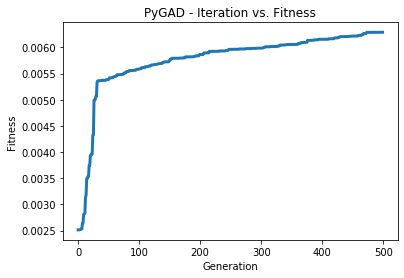
The next figure shows how the fitness value changes for the 500 generations used.